Bangchak Halts All Production at Bangkok Refinery After Explosion and Fire
An explosion and fire at Bangchak Corporation's 120,000-barrel-per-day Phra Khanong oil refinery in eastern Bangkok injured at least nine people on November...
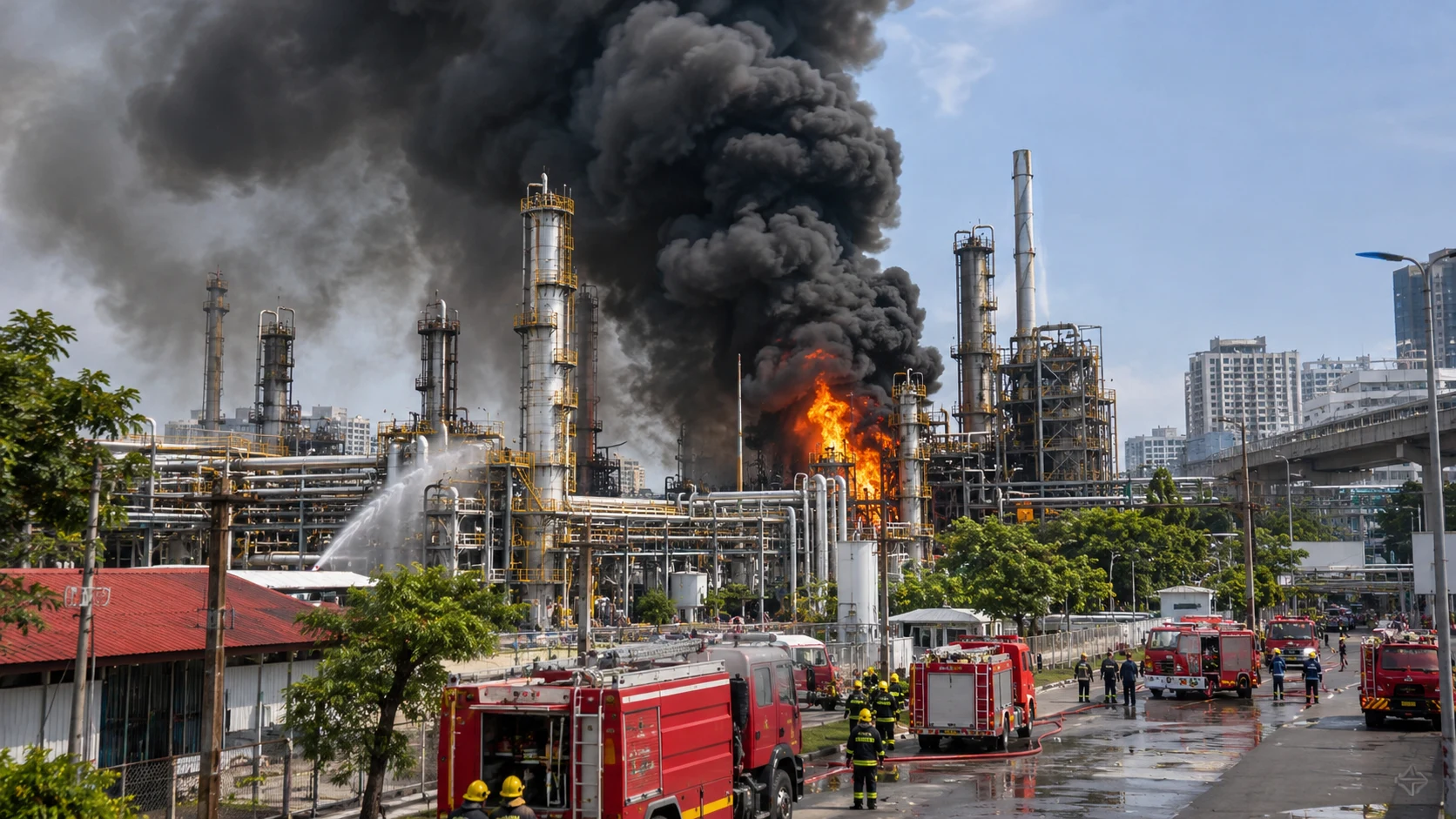
Flames and thick black smoke rose above eastern Bangkok on the afternoon of November 26, 2026. An explosion had hit Bangchak Corporation's Phra Khanong oil refinery in Thailand's capital between about 2:45 and 3:00 p.m. local time, setting off a major fire. The smoke spread across the eastern part of the city, prompting local authorities to issue evacuation warnings for nearby residents. Firefighters, emergency responders, and government agencies brought the blaze under control in around 30 minutes, keeping flames away from neighbouring industrial sites and homes. At least nine people were hurt in the incident, and Bangchak halted operations across every production unit on the grounds.
Early official accounts did not point to the same spot. Bangchak's preliminary inquiry traced the incident to the hydrocracking unit. Speaking separately, Energy Minister Akanat Promphan said the fire appeared to start near a distillation tower roughly 100 metres from the refinery's oil storage area. Nobody knows the exact cause yet. Investigators have still not established which piece of equipment failed or what sequence of events set off the blast.
Emergency medical reports put the injury toll at nine. Bangkok's Erawan Emergency Medical Centre reported at least nine people injured, four of them initially listed in serious condition, while later updates confirmed several personnel had suffered burns. Bangchak confirmed nine staff members were affected. Two have already gone home. While crews worked to contain the fire, the Bang Na District Office urged people living and working near the site to leave the surrounding area as a precaution, and drivers were told to avoid roads needed by emergency vehicles. People were allowed back once the fire was out, though precautionary advisories stayed in place and anyone within five kilometres was urged to stay alert for air pollution even after the immediate evacuation warning lifted.
Off-site, attention turned quickly to that black smoke. Air checks brought early relief. Thailand's Pollution Control Department sent monitoring crews into nearby neighbourhoods and collected initial readings between about 5:30 and 5:45 p.m., finding carbon monoxide and sulphur dioxide below hazardous levels. Benzene registered at 0.32 parts per million, far below the cited one-hour emergency guideline of 52 ppm. Bangchak separately reported that measurements taken within three to four kilometres of the facility fell inside normal limits. Crews kept monitoring nearby communities in the smoke's path anyway. Water tests were next, with environmental officials ordering checks on nearby waterways to see whether firefighting water or refinery wastewater had carried contaminants into local water sources.
Inside the plant, investigators will have to look closely at the hydrocracking unit. Modern refineries depend on hydrocrackers, which combine hydrogen, high heat, heavy pressure, and specialised catalysts to break heavier petroleum fractions down into diesel fuel, jet fuel components, and other lighter, higher-value refined products. That chemical step lifts fuel quality and squeezes more usable light fuel out of heavy crude. Because hydrocrackers run under intense conditions, investigators must examine the unit's hardware along with surrounding process systems and safety mechanisms before they can say what went wrong.
Every production unit at Phra Khanong remains shut down as a precaution while company engineers and state regulators inspect the complex. According to Bangchak's published operational data, the Bangkok plant holds a maximum, nameplate capacity of 120,000 barrels of crude oil per day, making it a significant piece of Thailand's energy infrastructure. Even so, Thailand's fuel network has room to absorb the hit. Phra Khanong is not the country's largest refinery, nor even Bangchak's biggest, since the company also operates a 174,000-barrel-per-day facility at Sriracha. Akanat Promphan indicated that overall national oil supplies should stay unaffected because five other refineries across Thailand can meet domestic fuel demand.
Still, the timeline matters. If the shutdown drags on, Bangchak's production volumes, refining schedules, and supply arrangements could all come under strain. Government officials have also made their condition clear: production cannot resume until the plant's safety, especially around its oil and gas storage systems, is established. As of November 26, 2026, Bangchak had announced neither a confirmed restart date nor a final damage assessment.
Phra Khanong has burned before. In July 2012, an earlier explosion at the same Bangkok refinery touched off a major fire that damaged nearby homes and forced roughly two weeks of repairs. Another serious fire at the identical complex raises questions about equipment reliability and industrial risk management at large petroleum facilities operating near populated urban areas.
Restarting Phra Khanong will take time. Bangchak and state authorities still need to isolate the technical failure behind the blast, put the hydrocracking unit and linked systems through full safety inspections, and keep up air and water testing beyond that first evening's sweep. Once damage is tallied, the company can set a safe timetable to restart operations, while Thailand's energy authorities watch domestic petroleum supplies closely for any sign of pressure.
ImageSource: ChatGPT
श्रेणी (Category): International News