3D Printing Houses in India: What It Actually Takes to Build One
3D-printed houses are changing construction in India, but building one involves much more than simply printing concrete walls. Here’s how the technology work...
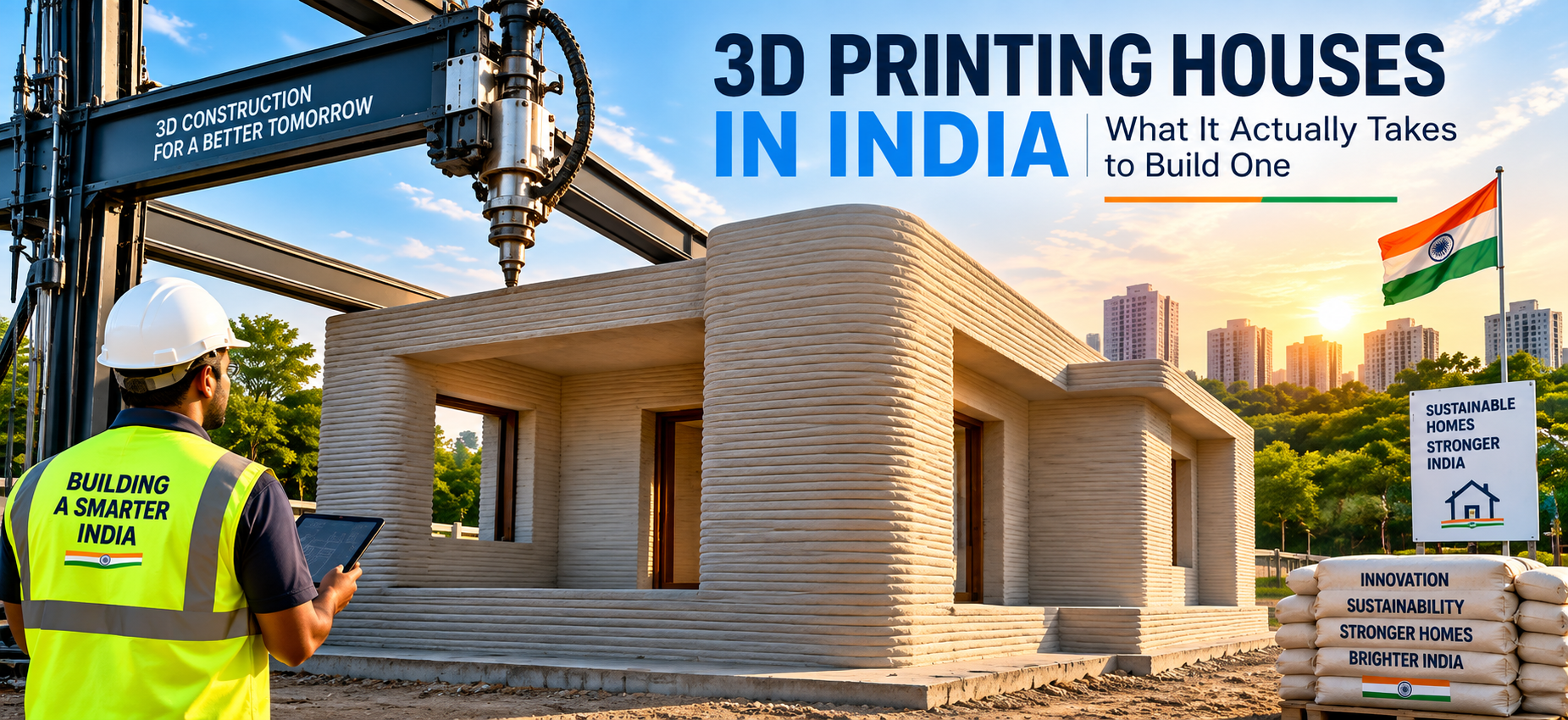
3D Printing Houses in India: What It Actually Takes to Build One
Talk to anyone who built a house in India recently, and they’ll tell you the exact same story. You set aside a budget, pick a contractor, and before you know it, you're knee-deep in disputes over cement brands, missing sand deliveries, and workers who simply stop showing up midway through the roof casting. What was supposed to be a neat six-month build easily stretches past a year.
That’s why those viral clips of robotic nozzles printing neat concrete walls in three days look so tempting. It makes you wonder why we aren't all just printing our houses already.
The reality, though, is a bit more grounded. Yes, the technology works, and yes, it’s being used right here in India. But between a fast-forwarded social media video and a real living room you can move into, there’s a whole lot of practical civil engineering that rarely gets talked about.
How It Actually Works on the Ground
Forget the idea of a giant toy plastic printer. When you print a building in India, you are pumping tons of heavy mortar mix under unpredictable weather conditions.
First, an architect builds a 3D CAD model on a computer, detailing every structural wall, door cutout, and internal pipe conduit. A software program then chops that design into hundreds of thin layers.
Out on the plot, a massive metal frame or a robotic arm gets anchored right over the foundation.
The concrete mix itself is where things get really tricky. You can’t just buy regular bags of cement and sand from the nearest depot. The mix has to be fluid enough to travel through hoses without blocking the pump, but stiff enough to set almost instantly once it leaves the nozzle. If it takes too long to cure, the bottom layers collapse under the weight of the new layers above them. In places like Delhi or Ahmedabad where summer temperatures cross 40°C, the mix dries out way too fast. In coastal areas like Mumbai or Kochi with high humidity, it behaves completely differently. Technicians have to constantly balance chemical admixtures right on site.
Once the mix is ready, the printer head moves along pre-programmed paths, laying smooth beads of concrete one on top of another until full-height walls stand finished.
The "3 Days to Build a House" Reality Check
We have all seen the catchy headlines: "Entire House Built in 72 Hours!"
Don't let that fool you. Those 72 hours only account for the robotic wall printing.
A bare concrete wall is not a home. To actually live in it, a long list of regular construction tasks still has to happen:
- The foundation still needs conventional digging, pouring, and days of water curing.
- Electricians need to snake conduit piping through hollow cavities in the printed wall.
- Plumbers have to cut channels, run water supply lines, and lay sewage pipes.
- Steel rebar ties and vertical structural rods must be anchored so the structure holds up against earthquakes.
- The RCC roof slab still has to be shuttered, cast, and left to cure.
- Local carpenters and tilers still have to fit window frames, hang doors, lay vitrified tiles, and apply final coats of putty and paint.
All told, a 3D-printed home usually takes somewhere between 3 to 6 weeks from site prep to handing over the keys. That is still lightning fast compared to nine months of bricklaying, but it’s certainly not happening over a long weekend.
Why India Is Actually Investing in This
Even with the caveats, there is genuine reason for excitement in India.
The biggest win is cutting down waste. On a standard Indian construction site, piles of chipped bricks, spilled gravel, and excess mortar clutter the road. Around 20% to 25% of building materials often go straight into the trash. With 3D printing, the nozzle places material only where the digital model demands it, bringing wastage down below 5%.
Then there is structural freedom. Try asking a local mason to construct a house with flowing, curved exterior walls. He’ll either quote double for custom shuttering or tell you it’s impossible. For a 3D printer, printing an S-curve takes the exact same effort and time as a straight wall.
We are already seeing real projects go up across the country. Companies like Tvasta, which spun out of IIT Madras, alongside infrastructure players like L&T, have built functional structures: India’s first 3D-printed post office in Bengaluru’s Cambridge Layout, multi-unit military shelters in high-altitude border areas, and model villas in Tamil Nadu.
What’s Still Slowing It Down?
So why don't you see a printer working on the empty plot down your street?
For starters, the equipment is pricey. An industrial construction printer is a major capital investment running into tens of lakhs or crores. Local contractors simply cannot justify that cost without back-to-back projects lined up.
Second, the supply chain for materials is still young. The proprietary dry-mix mortars containing specialized polymers and micro-silica come from only a handful of certified makers, which keeps material costs higher than basic brick and mortar.
Third, our building bylaws weren't made for this. Most municipal development authorities and standard NBC codes still look for conventional columns and brickwork calculations. Getting structural permits for 3D-printed load-bearing walls often requires specialized structural vetting from places like the IITs or SERC before local bodies give the green light.
Finally, you need different skills. You don't need dozens of manual brick carriers, but you do need trained technicians who understand pump pressure, robotic axes, and concrete rheology. That specialized workforce is still being trained.
What the Next Few Years Look Like
Nobody in the industry expects 3D printers to replace everyday brick masonry anytime soon, especially for small home renovations or tight alleyways where a heavy gantry cannot fit.
Instead, the technology is finding its sweet spot in large government housing initiatives, disaster-relief shelters, highway infrastructure, and specialized commercial builds where speed and precision matter most.
As local raw materials become cheaper and portable printer rigs get easier to set up, 3D printing will slowly stop feeling like a science experiment and quietly become just another standard tool in India's building toolkit.
श्रेणी (Category): Technology