How Ladakh Is Rerouting Glacier Runoff to Save Tso Kar Lake
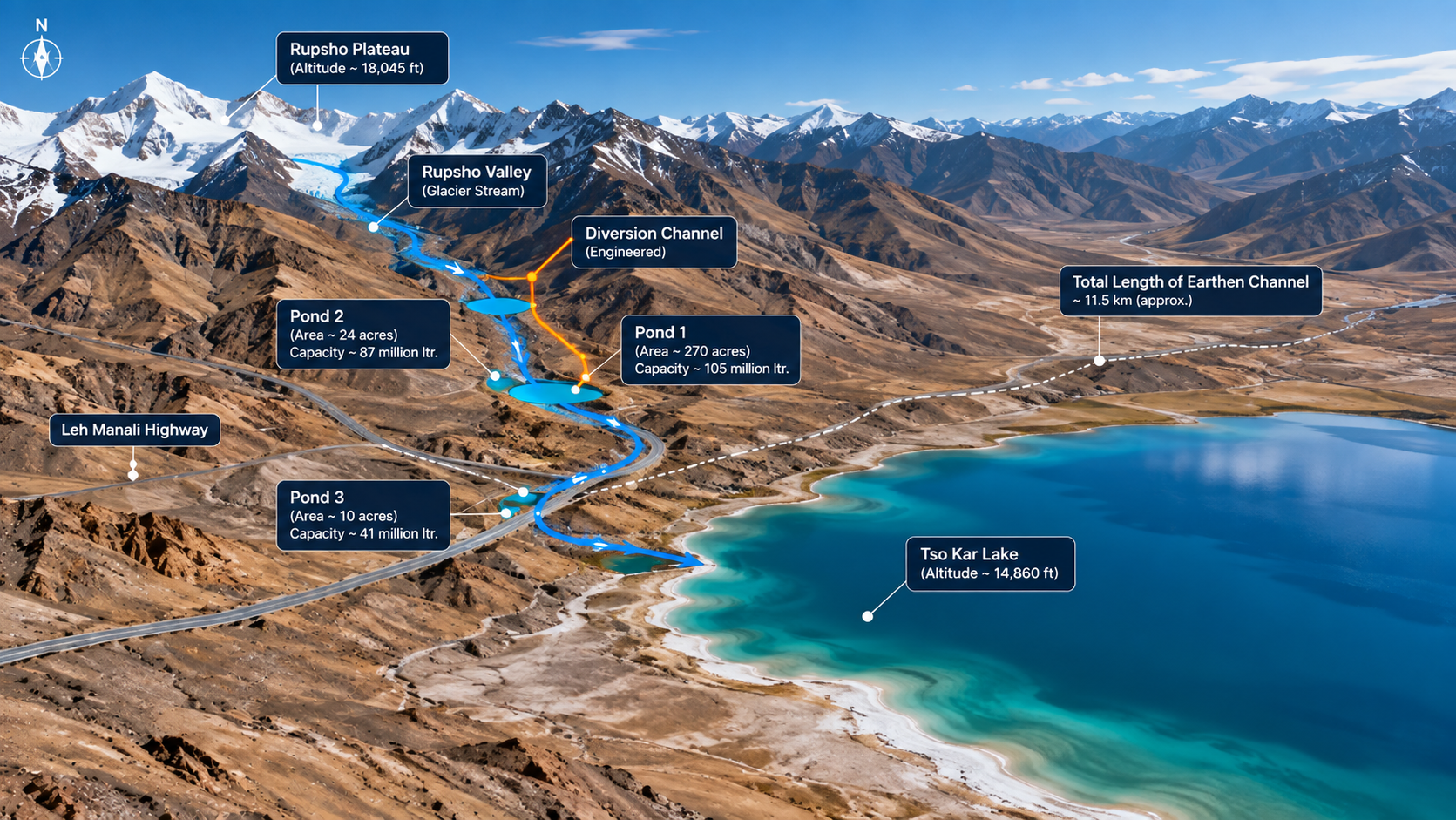
Ladakh is rerouting glacier runoff from the Rupsho Kharnak stream to help restore the shrinking Tso Kar Lake, bringing around 320 million litres of water tow...
How Ladakh Is Rerouting Glacier Runoff to Save Tso Kar Lake
Tso Kar is running out of water, and it has been for years.
Situated out in Ladakh’s high Changthang plains, this high-altitude salt lake is shrinking fast. Less snow falls in the winters now. Springs dry up earlier in the spring. For the birds and wildlife that rely on the wetland, the shrinking waterline is bad news.
Now, local authorities are trying something straightforward: bringing water in from a nearby glacier stream that nobody was using.
Where the Water Is Coming From
Up at roughly 18,000 feet sits the Rupsho Kharnak glacier stream.
Every summer, melting ice sends torrents of freshwater down through uninhabited rocky valleys. Most of that water simply drained away without feeding into Tso Kar’s basin.
The Ladakh administration, headed by Lieutenant Governor V.K. Saxena, decided to tap that flow.
Engineers built channels to divert around 132 cusecs of stream water directly toward the lake basin. That works out to roughly 320 million litres arriving every single day.
Why Tso Kar Needs Saving
Tso Kar is not just an empty salty basin on a map.
Back in 2020, it earned global recognition as India’s 42nd Ramsar site. The wetland complex is a crucial breeding area for rare birds like the black-necked crane and bar-headed geese.
It also sustains the pasture grounds surrounding the water.
Local Changpa nomads move their herds across these plains throughout the year. Their prized Changthangi goats—the ones that produce ultra-fine Pashmina wool—rely on these wetland grasses to survive harsh desert winters.
If Tso Kar dries out, the entire local grazing cycle takes a direct hit.
Working at 18,000 Feet
Doing construction work at this altitude is brutal on people and equipment.
Temperatures routinely drop well below freezing even outside winter. Sudden blizzard conditions can roll in within minutes, cutting off temporary tracks across the scree.
At 18,000 feet, diesel engines lose power because of thin air, and workers tire out twice as fast.
Getting pipes, excavation gear, and field crews up to the glacier stream took weeks of difficult hauling over loose scree and unpaved terrain.
What the Inflow Actually Does
The goal is simple: offset high evaporation and boost the lake's baseline volume.
Ladakh is a high-altitude desert. Rainfall is minimal, rarely topping 100 millimeters in an entire year. That means lakes depend almost entirely on glacier melt and groundwater seep.
By adding 320 million litres daily, engineers hope to push water levels back up toward historic marks within twelve to eighteen months.
The Bigger Picture: Himalayan Glaciers Are Changing
This project is happening against a backdrop of rapid warming across the Hindu Kush Himalayas.
Glaciologists have repeatedly pointed out that mountain streams will see unusual flow spikes over the next few decades as glaciers melt faster, followed by sharp declines once ice volumes dwindle.
Catching meltwater while it is still flowing makes immediate practical sense for local regions.
Rather than building massive concrete dams or trying to drill deep into bedrock aquifers, working with natural gravity channels keeps the intervention light and relatively fast to deploy.
Keeping an Eye on the Results
Nobody expects a single channel to solve every long-term water problem in Changthang.
Evaporation rates, regional snowfall, and summer heatwaves will all dictate how much water Tso Kar actually retains over the next decade.
Ground crews and satellite tracking will need to keep tabs on seasonal water spread, salinity levels, and bird nesting patterns around the newly fed sections.
Still, the initial response looks promising.
A Model for Mountain Water Management
High-altitude water diversion like this could offer a working template for other stressed lakes across Ladakh, Spiti, and neighboring Himalayan valleys.
The focus here is practical: identify surplus runoff that gets lost down uninhabited gullies and route it where nature and people need it most.
On September 14, 2026, the administration highlighted the Tso Kar project as one of its priority environmental achievements.
If the diverted water does its job over the coming seasons, Tso Kar may well regain its footing as one of Ladakh’s most resilient wetland habitats.
For now, the fresh glacier water is flowing, and the lake is slowly getting its volume back.
It proves that sometimes the most effective conservation solutions do not need complicated technology—just smart, timely intervention where it counts.
श्रेणी (Category): Environment